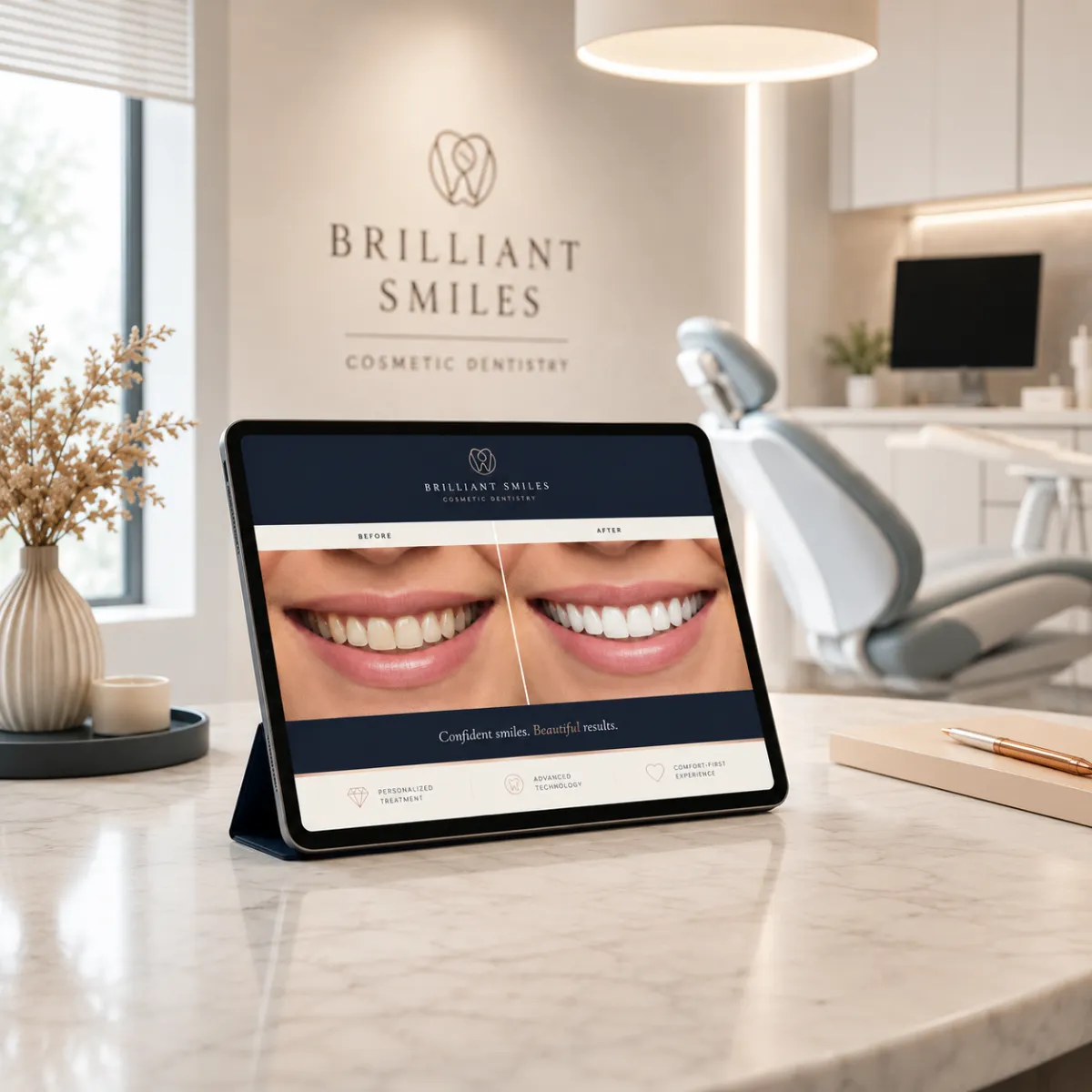
Before-and-After Photos: The Trust Signal You're Probably Underusing | Brilliant Brand Solutions
66.6% of cosmetic dental patients report that before-and-after photos on social media had a significant impact on their choice of dentist.
Not a mild influence. Not a factor they considered. A significant impact — on who they called, who they booked with, who they trusted with their face.
That number comes from peer-reviewed research published in Bioinformation in 2025, based on a study of 335 adults making aesthetic dental decisions. And it sits alongside a separate finding from PubMed that the presence of a dentist's pre-and-post treatment cases on social media is an effective marketing tool, particularly on Instagram, where it measurably influences provider selection.
Your before-and-after photos are not a nice-to-have. For a meaningful percentage of the cosmetic patients you most want to attract, they are the deciding factor.
And most cosmetic practices are using them in the most basic, least effective way possible.
Why Most Before-and-After Galleries Are Not Working
Walk through the websites of cosmetic practices in any major market and you will see the same thing: a gallery page, usually titled "Before & After" or "Smile Gallery," populated with clinical-quality images arranged in a grid. Some are impressive. Most look interchangeable with every other practice in the city.
The problem is not the photos. The problem is the context — or the absence of it.
A before-and-after image without a story is just a comparison. It shows what changed. It does not show why it matters, who the patient was, what they were anxious about, how long it took, or what it felt like to see the result for the first time. It gives a prospective patient visual evidence of technical skill. What it does not give them is the thing they actually need to decide: emotional permission to want that for themselves.
Research from Nature (2024) found that the type of content most likely to influence a patient's decision to pursue aesthetic dental treatment was posts from dental clinics or dentists — specifically ones that featured visualization of the treatment process and results. Not celebrity endorsements (only 37.3% of patients were influenced by celebrity-affiliated practices). Not promotional offers (which influenced only 33.7%). Treatment visualization — real results, presented in a way that connects with a real patient's aspiration.
The gap between what most practices post and what actually converts is not about photo quality. It is about narrative.
The Anatomy of a Before-and-After That Converts
There is a specific structure to the before-and-after presentations that generate consultations — and it is not complicated, but it does require intentionality.
The Patient Context
Who was this person before they walked in? Not their demographics — their emotional state. Were they hiding their smile in photos? Had they been thinking about this for years? Were they about to get married, change careers, hit a milestone birthday?
You do not need a paragraph. One or two sentences of patient context transforms a clinical comparison into a story a prospective patient can place themselves inside. "Sarah had been self-conscious about her smile since her teens and finally decided the timing was right at 38." That is enough. It is specific, it is human, and it gives the next patient permission to say: that sounds like me.
The Treatment Named Clearly
One of the most consistent failures in cosmetic practice before-and-after content is the absence of treatment specificity. Patients searching for "porcelain veneers before and after" or "smile makeover results" need to find content that explicitly names what was done. This matters for three reasons: it helps prospective patients self-qualify, it improves your search and AI visibility for treatment-specific queries, and it builds clinical authority by demonstrating the range of your expertise.
Label every case. "8 upper porcelain veneers." "Full smile makeover with composite bonding and whitening." "Invisalign completion, 14 months." This is not clinical jargon — it is the language your ideal patient is already searching.
The Emotional Outcome
What did the result give the patient? Not the clinical outcome — the life outcome. This is the piece most practices omit entirely, and it is arguably the most powerful element of the presentation.
"She cried at the reveal." "He said it was the first time in twenty years he felt confident smiling in a photo." "She booked her engagement shoot the same week."
These are the sentences that convert the next patient. Because the patient browsing your gallery at 10pm is not evaluating your porcelain work. She is asking: will this change something for me the way it changed something for her?
Where to Use Them — and Where Most Practices Stop Too Soon
Most cosmetic practices confine before-and-after content to a website gallery and occasional social posts. That is leaving the majority of its potential value untouched.
Social Media — With a Strategy
Instagram remains the highest-impact platform for before-and-after content in cosmetic dentistry, with PubMed research confirming it as a statistically significant channel for provider selection. But posting a before-and-after without context is a missed opportunity. The caption is where the story lives. One or two sentences of patient narrative, the treatment named, the outcome described — that is the combination that stops the scroll and generates the DM or the profile click.
Carousel format performs particularly well for before-and-after content because it extends engagement. Slide one: the before. Slide two: the after. Slide three: the story. Slide four: the CTA. A patient who swipes through four slides is significantly more invested than one who glanced at a single-image post.
The Consultation Room
Before-and-after photos are among the most powerful in-consultation tools a cosmetic practice has — and the least systematically used. A curated selection of cases relevant to the patient's treatment interest, presented during the consultation by the doctor or treatment coordinator, dramatically increases case acceptance.
The patient sitting across from you is making a trust decision in real time. Showing them a relevant, well-presented before-and-after with a brief narrative — "This patient had a similar starting point to yours and here is what we were able to accomplish in about three weeks" — gives them the concrete evidence and emotional permission to say yes.
AI and Search Visibility
Well-captioned before-and-after content on your website — with treatment names, patient narratives, and procedure-specific language — is also AI-visible content. When a patient asks ChatGPT or Gemini which cosmetic dentist does the best veneer work in their city, AI platforms favor practices with rich, specific, treatment-documented content over those with thin or generic galleries. Your case documentation is not just marketing. It is visibility infrastructure.
The Consent and Workflow Gap
The most common reason cosmetic practices underuse before-and-after content is not reluctance — it is the absence of a system. No one has built the workflow that captures photos at the right moment, secures consent in a natural and patient-friendly way, and routes the assets to wherever they need to go.
The practices that consistently generate strong before-and-after content have made it part of the clinical workflow, not a marketing afterthought. Consent is obtained at the new patient appointment, part of the standard paperwork and presented as a way the practice shares its work with the community. Photos are taken at baseline and at the reveal as a standard clinical step. The marketing team or VA receives the images automatically and knows what to do with them.
This is a system. It runs without the doctor thinking about it every time. And once it runs, the content compounds — every completed case adds to a library that builds authority, drives consultations, and generates AI visibility for years.
The Strategic Consulting Connection
Building that system — the consent workflow, the narrative framework, the multi-channel distribution strategy, the consultation room integration — is strategy work. It sits at the intersection of clinical operations and brand positioning, and it is different for every practice depending on their case mix, team structure, and target patient.
If you want to talk through what a before-and-after content strategy looks like for your specific practice — including how to turn your completed cases into a compound visibility asset — that is exactly the kind of work a strategic consultation is built for.
Book a Strategic Consultation →
Your work deserves to be seen. The right system makes sure it is.
Sources & Further Reading
Bioinformation — Cross-Sectional Study on Social Media Impact on Aesthetic Dental Decisions (2025)— 335 adults; 66.6% reported before-and-after photos on social media significantly influenced their dentist selection; celebrity endorsements influenced only 37.3%.pmc.ncbi.nlm.nih.gov/articles/PMC12697506
PubMed — The Impact of Dental Photography on Social Media on Patients' Selection of Dentists (2025)— Peer-reviewed study confirming pre-and-post treatment cases on social media as an effective marketing tool; Instagram identified as a statistically significant platform for provider selection.pubmed.ncbi.nlm.nih.gov/39838400
Nature Scientific Reports — Social Media's Influence on Aesthetic Dental Treatment Decisions (2024)— Posts from dental clinics featuring treatment visualization were the most influential content type; promotional content and celebrity endorsements ranked significantly lower.nature.com/articles/s41598-024-72442-8
Dental Growth Solutions — High-Impact Content Marketing for Dentists (2026)— Before-and-after photos paired with real patient narratives as the highest-converting content format in cosmetic dental marketing.dentalgrowthsolutions.com/blog
