Google Reviews Policy: What Every Office Needs to Know (April 2026 Update)
Overview
Google has made its most significant overhaul to Business Profile review guidelines in years, with two major policy events happening back-to-back on April 16–17, 2026. The changes target practices that were previously widespread — and that many dental offices may still be running today.
--> Reviews that violate the new rules are being removed quietly and automatically, and repeated violations can result in public warning banners, profile restrictions, or full suspension.
This summary covers exactly what changed, what is now banned, and what a compliant review process looks like.
What Happened (The April 2026 Double Event)
April 16, 2026 — New Protections for Business Owners
Google released its 2025 Trust and Safety Report alongside three new defensive features:
Upgraded pre-publication scam detection— Coordinated fake review campaigns and extortion attempts are now caught before they post, not after.
Gemini-powered profile edit moderation— Google's AI now reviews suggested edits to your business name, hours, and categories before they go live across all platforms.
Proactive email alerts— Verified Business Profile owners now receive alerts before important profile edits go live, giving them a chance to approve or reject changes.
April 17, 2026 — Two New Bans Added to the Rating Manipulation Policy
The very next day, Google quietly added two explicit prohibitions to the Maps User Generated Content Policy, spotted by Google Diamond Product Expert Amy Toman (Search Engine Roundtable):
Merchants cannot direct staff to solicit a specific number of reviews (review quotas/contests).
Merchants cannot ask for reviews that include specific content — including content that names a staff member.
Both were common industry practices. Both are now violations.
Complete List of Prohibited Practices (Current Policy)
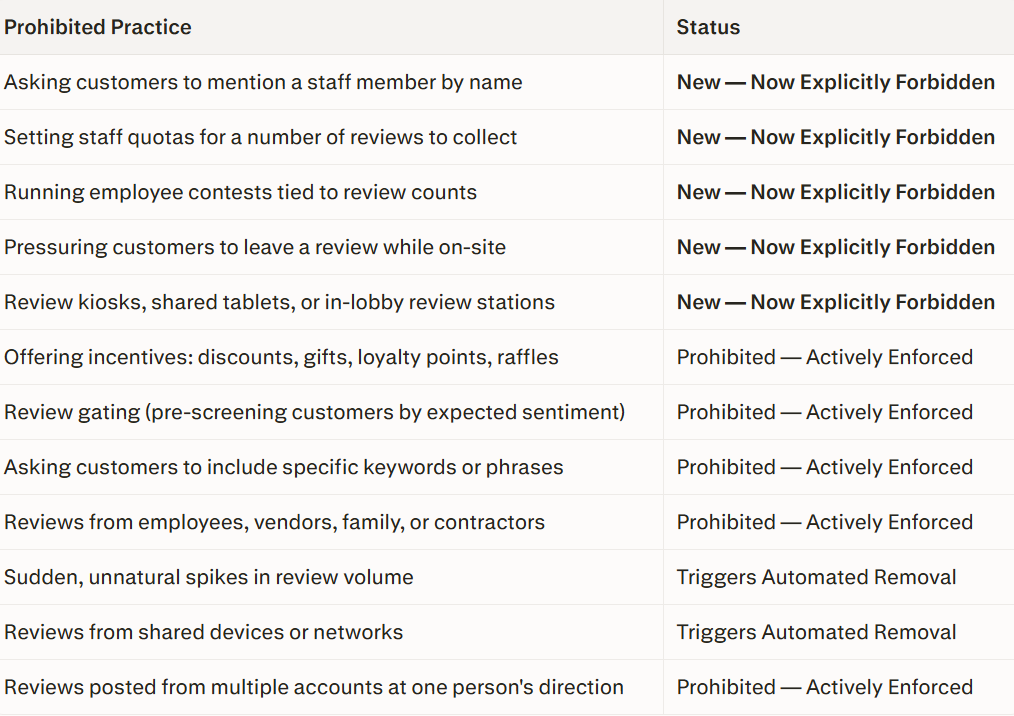
The following are now explicitly banned under Google's Rating Manipulation and Fake Engagement policies (LaunchCodeX, Three Chapter Media):
The Staff Name / Employee Contest Rule — Explained
This is the change most likely to affect dental offices immediately.
For years, practices trained front desk staff and coordinators to say things like:
"Would you mention Dr. Smith's name in your Google review?"
"We're doing a contest — whoever gets the most reviews this month wins a gift card."
"Can you give us five stars and mention Sarah by name?"
All three scenarios are now explicit violations of the Maps User Generated Content Policy under the "Rating Manipulation" section (PPC.land).
Why does Google care about name mentions? When reviews consistently follow an unnatural pattern — repeatedly naming the same staff member in ways real customers rarely write organically — Google's AI flags it as coordinated or scripted. The review is then treated as guided rather than genuine, and it is removed (SearchLab Digital).
Important nuance: A patient who voluntarily mentions a provider's name in a review they write on their own is not a violation. The problem is when the business instructs or requests that. Natural, unsolicited name mentions are fine. Google's policy distinguishes between what businesses direct versus what patients freely choose to write.
One more thing to watch: Industry experts note that the phrase "specific content" in the new clause may be read broadly — potentially covering any scripted prompting, including asking patients to mention a specific treatment or procedure they received. Until Google clarifies the full scope, keep every review request completely open-ended (LaunchCodeX).
Review Gating — The Practice Most Offices Don't Realize Is Banned
Review gating is the practice of pre-screening patients before sending a review request — only asking patients you expect will leave a positive review, while skipping those who had a less-than-perfect experience.
This has been against Google's rules for some time, but enforcement has intensified. It includes:
Sending a satisfaction survey first and only forwarding happy patients to the review link
Using a third-party widget that filters responses before directing anyone to Google
Skipping patients who had a complaint, billing issue, or incomplete treatment
The policy requires that review requests go to all patients equally, regardless of anticipated sentiment (CanvasMaster SEO). A profile with suspiciously perfect scores and no negative reviews can trigger algorithmic scrutiny before any human complaint is ever filed.
How Google Detects Violations — AI Enforcement Is Now Proactive
Google's enforcement is no longer reactive. The platform removed or blocked over 292 million policy-violating reviews in 2025— roughly 22% of all review activity that year (PPC.land).
Google's Gemini-powered systems monitor:
Review volume spikes— a sudden influx in a short window triggers automatic review
Device and IP clustering— multiple reviews from the same network, device, or location
Account age and history— reviews from brand-new accounts with no other activity
Content similarity— reviews using identical or near-identical phrasing
GPS/location context— reviews written while a patient is physically still in your office
Reviewer behavior patterns— accounts that only review one business type or follow unnatural timing
Reviews can be removed without any notification to the business. They simply disappear (Three Chapter Media).
Consequences for Violations
Penalties escalate based on severity and frequency (LaunchCodeX):
Silent review removal— reviews are removed with no alert to the business.
Temporary review freeze— the profile loses the ability to receive new reviews for a period of time.
Unpublishing of existing reviews— current reviews are temporarily hidden.
Public consumer warning banner— a visible message appears on your Google Maps listing alerting potential patients that fake reviews were removed.
Full profile suspension— for repeated or severe violations.
Legal Risk: The FTC Consumer Review Rule, which took effect October 21, 2024, imposes civil penalties of up to $53,088 per violation— and each fake or manipulated review counts as a separate violation (Respect Network). In December 2025, the FTC issued its first enforcement wave, sending warning letters to ten companies. Buying or manufacturing fake reviews is now a federal offense.
What You CAN Still Do
Asking for reviews is still fully allowed. The restriction is on how you ask, who you ask, and what content you ask for. A compliant review program:
Sends neutral requests to every patient after a completed appointment
Delivers the request through your own CRM, email, or text — not a third-party sentiment screener
Uses completely open-ended language: "We'd love to hear about your experience" or "Your honest feedback on Google means a lot to us"
Uses QR codes or review links from your Google Business Profile dashboard (not third-party redirect tools)
Does not specify a star rating, staff name, treatment, or any other content to include
The key phrase in Google's own policy: merchants are allowed to "solicit or encourage the posting of content that does represent a genuine experience, without offering incentives or attempting to influence the rating or the contents of the review."(Google Support)
Immediate Action Checklist for Your Office
Use this list to audit your current review process:
Audit all review request templates— Remove any mention of specific staff names, star ratings, keywords, or treatment names
Shut down any employee review contests or quota programs— These are now explicit violations
Remove in-office kiosks, shared tablets, or QR stations used for real-time review collection
Stop review gating— Send requests to all patients equally, not just those who seemed happy
Verify your Google Business Profile— Unverified profiles receive none of the new protective alerts
Enable proactive email notifications— Go to Settings > Notifications in your GBP dashboard and turn on alerts for edit suggestions, new reviews, and Q&A
Review the past 60 days for missing reviews— If reviews have disappeared, look for a common pattern (shared device, scripted language, name mentions)
Check your appeal window— If legitimate reviews were removed, you get one appeal per review through the Reviews Management Tool
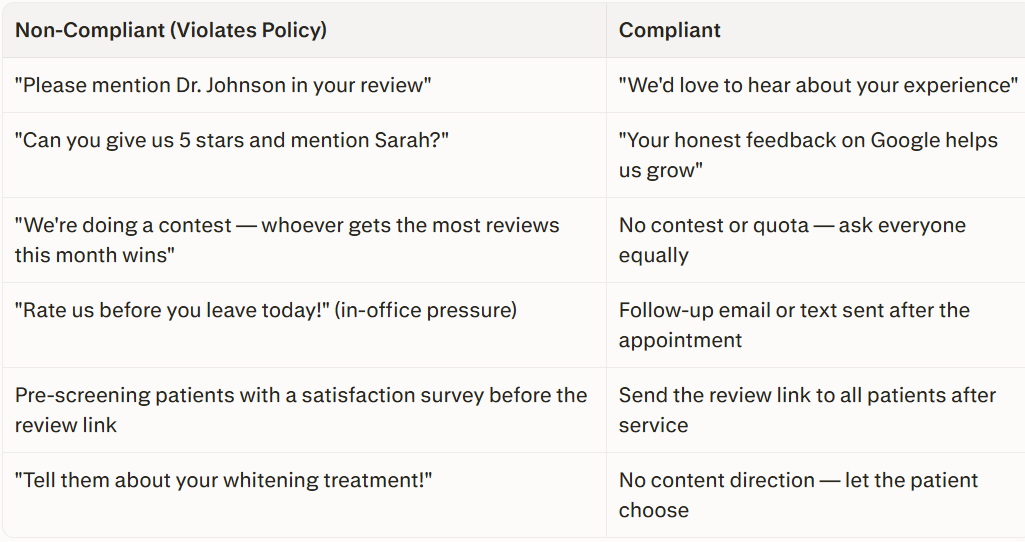
What Compliant Language Looks Like
How to Remove Reviews That Violate Google's Policies
If your practice is the target of spam or fake reviews, here is the process (Wiremo):
Report the review through the Reviews Management Tool in your GBP dashboard — select the most specific violation category
Wait 5 days, then check status
If denied, submit a one-time appeal with documented evidence (service records, screenshots, account behavior)
Save your case number from the appeal confirmation email
If still unresolved, escalate to the Google Business Profile Help Community with your case number and profile URL
As a last resort, use Google's legal removal request for defamatory or legally actionable content
Key Takeaway
Google has shifted from counting review volume to evaluating review signal integrity. A smaller number of authentic, unscripted, well-distributed reviews now carries more algorithmic weight than a large volume of coached or patterned reviews. Practices that adapt their review process now — eliminating name prompts, staff contests, and in-office pressure — are positioned to gain a competitive advantage as non-compliant profiles get flagged and filtered.
The bottom line: ask everyone, keep it neutral, stay out of the content.
