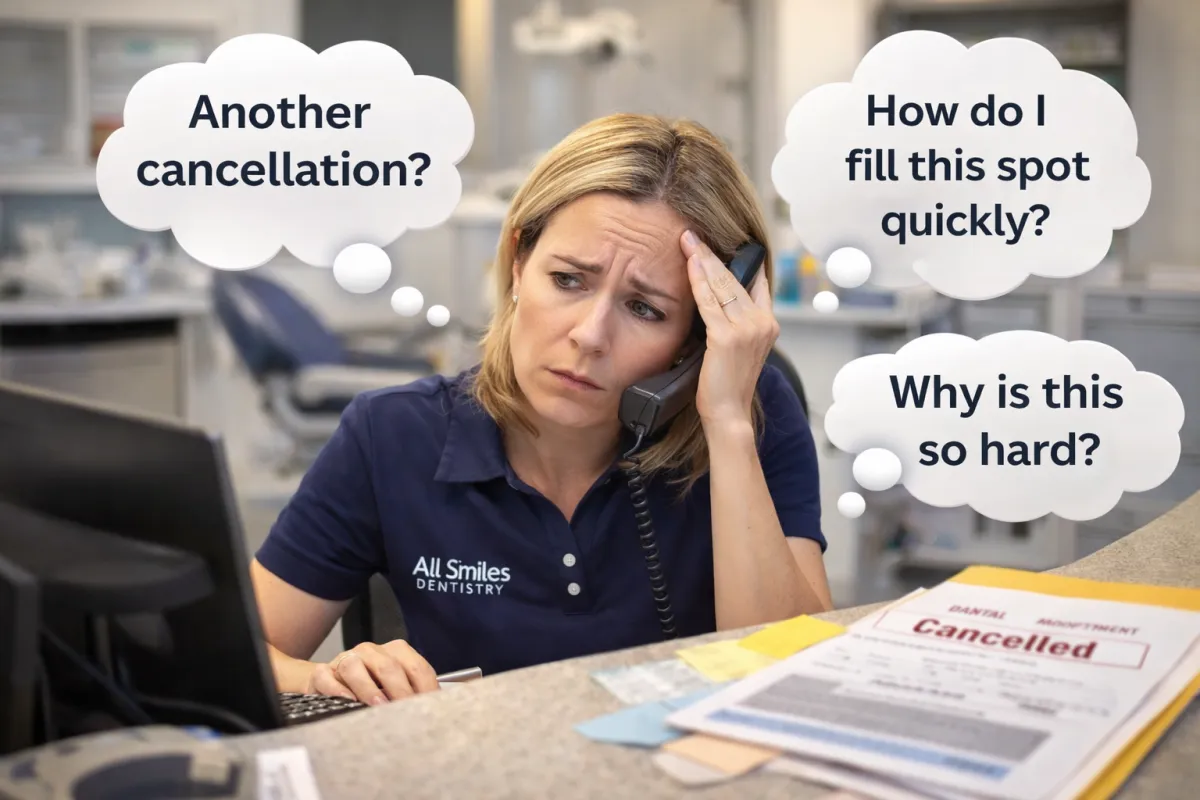
Why Last-Minute Dental Cancellations Create More Stress Than Lost Revenue
Last-minute cancellations are often blamed for lost revenue.
But inside a dental office, that’s rarely the real issue.
What actually hurts is the stress spike—the sudden disruption that turns a full, manageable day into a reactive scramble. For dental office managers and front desk leads, it’s not just about an empty chair. It’s about everything that breaks because of it.
The Real Cost of a Last-Minute Cancellation Isn’t the Empty Chair
Lost production is measurable.
Stress is not.
And yet stress is what lingers long after the appointment slot passes.
A single cancellation can derail focus, interrupt workflows, strain the team, and change the emotional tone of the entire day. Even if the practice can “absorb” the revenue loss, the operational and mental cost is still paid—often repeatedly.
A Typical Cancellation Scenario Every Dental Office Recognizes
It’s 10:17 AM.
The 1:30 PM appointment cancels.
You already have:
Phones ringing
A patient waiting at the desk
Insurance portals open
Three things you were in the middle of finishing
Now everything stops.
You shift gears instantly:
Who should we call?
Should we text?
Is this hygiene-only?
Do we post on social?
What did we say last time?
Nothing is technically wrong—but the day suddenly feels off.
That’s not about revenue. That’s about disruption.
Why Lost Revenue Isn’t What Actually Wrecks the Day
The financial impact of one cancellation is usually recoverable.
The mental impact is cumulative.
Each cancellation forces the front desk into reactive mode:
Pausing important work
Switching tasks mid-stream
Making fast decisions with no clear system
Carrying the emotional weight of “fixing” the schedule
The chair may be empty for an hour.
The stress lasts much longer.
The Hidden Stress Triggers Behind Last-Minute Cancellations
Scrambling to Fill a Spot While Already Overloaded
There’s no extra time carved out for cancellations. They arrive on top of everything else—forcing immediate action with zero margin.
Task Switching That Destroys Focus
Stopping mid-task to chase a replacement appointment drains energy and breaks momentum. Even when the chair gets filled, focus doesn’t fully return.
Decision Fatigue at the Front Desk
Each cancellation requires new decisions:
Who do we contact?
What do we say?
How do we say it this time?
That mental load adds up quickly.
The Emotional Drop That Kills Momentum
Once a cancellation hits, the day can feel “ruined”—even if the schedule looks fine on paper. Morale dips. Tension rises.
When Cancellations Become Burnout
One cancellation is manageable.
A pattern of them creates exhaustion.
When staff are constantly bracing for disruption, burnout isn’t far behind.
The Pressure to “Post Something” Right Now
Social media becomes a last-minute lifeline—often rushed, inconsistent, and stressful. Instead of confidence, it adds more pressure.
The Real Problem: People Are Carrying What Systems Should Handle
Office managers aren’t failing.
They’re being asked to improvise under pressure—again and again.
When every cancellation requires someone to invent messaging, decide channels, and react emotionally in real time, stress becomes inevitable. This isn’t an effort issue. It’s a systems gap.
This is why having a repeatable process for filling last-minute openings matters more than working harder — especially for front desk teams managing constant interruptions.
Strong practices don’t rely on hero mode.
They rely on preparation.
What a Better Cancellation System Actually Looks Like
A better system:
Removes decision-making in the moment
Provides ready-to-use language
Works across text, email, and social
Supports staff instead of draining them
Some practices quietly use tools or automations so last-minute openings don’t derail the entire day. The goal isn’t perfection—it’s chaos control.
From Scramble to Control: Filling Chairs Without the Stress
Imagine the same cancellation—handled differently.
No guessing.
No rewriting messages.
No panic posting.
Just clear, consistent outreach that can be sent in minutes.
That’s the difference between scrambling and leading.
A Smarter Way to Handle Last-Minute Openings
The Fill the Chair GPT was built specifically for dental office managers and front desk teams who are tired of reinventing the wheel every time a cancellation hits.
It provides:
Ready-to-use messaging for email, text, and social
Clear prompts that are mindful of HIPAA concerns
A calmer, faster way to respond—without starting from scratch
If last-minute cancellations are stealing more energy than revenue, this tool belongs in your toolkit.
Stop Scrambling. Start Filling Chairs with Confidence.
The Fill the Chair GPT gives dental office managers ready-to-use messaging for last-minute openings—so cancellations don’t derail the entire day.
Less stress.
Less decision fatigue.
More control.
If last-minute cancellations are stealing more energy than revenue, there is a better way.
The Fill the Chair GPT gives dental office managers ready-to-use messaging for last-minute openings—without scrambling or reinventing the wheel.
Designed specifically for dental front desks and office managers.
