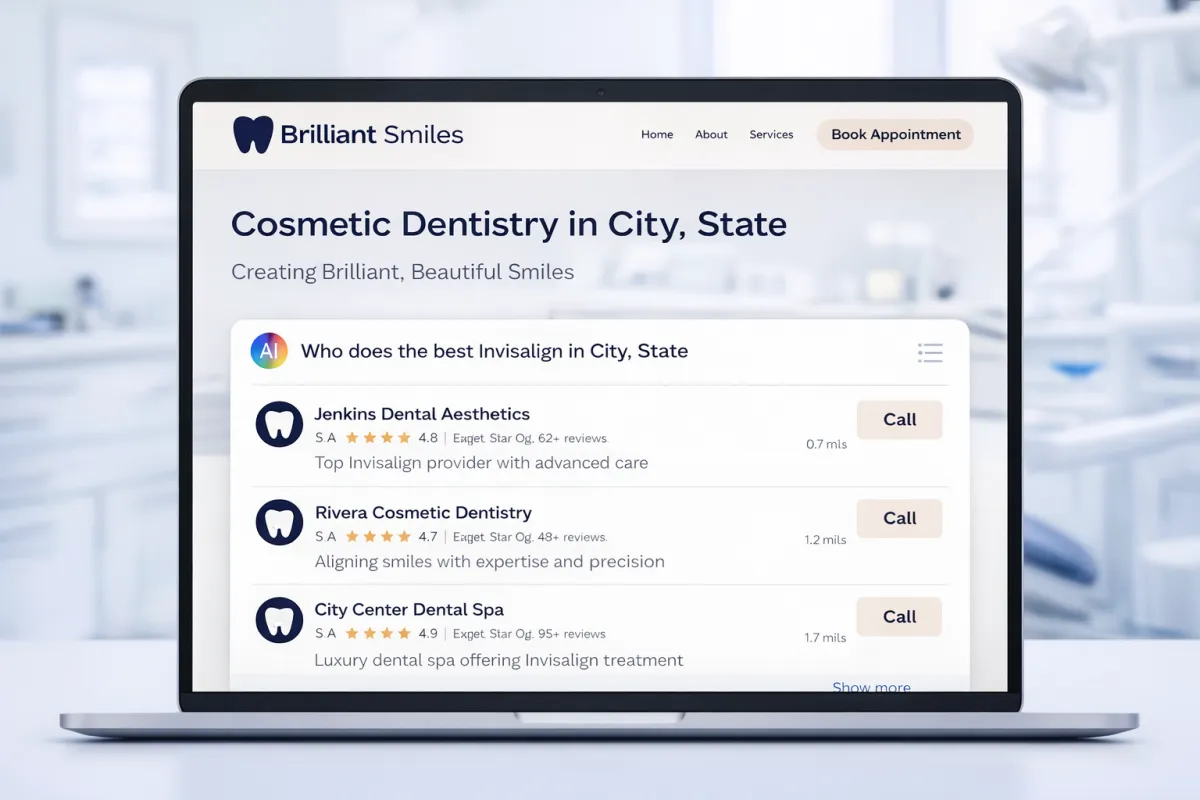
What AI Looks For When Recommending a Cosmetic Dentist | Brilliant Brand Solutions
Only 1.2% of local businesses get recommended by ChatGPT.
Let that number land for a second.
--> Not 12%.
--> Not even 5%.
One point two percent.
When someone opens ChatGPT and types "who's the best cosmetic dentist near me," the algorithm is running your practice through a filter so tight that 98.8% of businesses never make the list.
Google's local 3-pack, for comparison, shows up for 36% of businesses. That means AI is roughly 30 times more selective than traditional search. You've been playing a completely different game without knowing the rules.
This post is about the rules.
The AI Search Shift (Why This Matters Right Now)
Your highest-value patients — the ones who want full smile makeovers, porcelain veneers, and same-day everything — are not calling around. They're doing what affluent buyers always do: research quietly and decide privately. And increasingly, that research starts in an AI chat interface, not a search bar.
According to the SOCi 2026 Local Visibility Index, which analyzed over 350,000 business locations, Gemini recommends about 11% of local businesses and Perplexity recommends around 7.4%. ChatGPT, the most popular, is the most exclusive — sitting at that 1.2% figure. These aren't soft estimates. They're the result of a massive, methodical audit of how AI platforms actually behave when someone asks for a local service recommendation.
Here's the part that should stop you cold: business profile information was only 68% accurate on ChatGPT and Perplexity. That means roughly a third of what AI is pulling about your practice could be wrong — outdated phone numbers, old addresses, missing service details. And when AI is wrong about you, patients never find you. They don't dig deeper. They move on. The accuracy of your online information signals credibility to not only AI and voice agents, but to patients.These patients might already be anxious, they work up the nerve to call and the listed number belongs to someone's Aunt Grace in the next town.
The new discipline built to fix this is called GEO — Generative Engine Optimization. Think of it as SEO with different physics. The goal isn't just to rank in a list. It's to become the source AI trusts enough to cite by name when someone asks for the best cosmetic dentist in your city.
The Ranking Signals AI Actually Uses
There's no mystery algorithm to decode here. AI platforms pull from a predictable set of sources — Google Business Profile, Yelp, Healthgrades, Zocdoc, RealSelf, ADA and AACD directories, local news sites, and community blogs. What matters is how your practice shows up across all of them, consistently, with the right kind of information.
The SOCi research organizes AI ranking signals into what they call the FACTS framework: Freshness, Authority, Consistency, Trust, and Specificity. Here's what each of those looks like in practice for a cosmetic dental office.
1. NAP Consistency — The Unsexy Foundation
Name, Address, Phone. Identical. Everywhere.
Not "close enough." Not "we moved two years ago and updated most of them." If your practice name is listed as "Bright Smiles Dental" on Google, "Bright Smiles Dental Studio" on Yelp, and "Dr. Lisa Carter DDS" on Healthgrades, AI treats those as three different entities and discounts all of them.
This is the easiest problem to fix and the most commonly ignored. It also happens to be the first thing AI cross-references when assessing whether you're a real, established, trustworthy practice. One afternoon of cleanup across your top 10 listings could move the needle more than six months of content work.
2. Review Volume, Recency, and Specificity
ChatGPT recommends businesses averaging 4.3 stars. Not 3.8. Not "mostly good." AI doesn't use reviews as a ranking signal — it uses them as a filter. Practices below the threshold don't get considered. They're out before the round starts.
But here's what most practices don't know: review specificity matters as much as volume. Twenty detailed, recent reviews that mention "porcelain veneers," "Invisalign consultation," and "smile makeover" carry more weight with AI than 200 old reviews that say "great office, friendly staff." Generic reviews give AI nothing to index. Specific reviews give it searchable, quotable content.
Your highest-value patients are capable of leaving extraordinary reviews. They just need to be asked — and given a little direction. Not scripted. Just pointed toward what to mention.
Why not have them fill out a form as part of the checkout process? Or a QR code that leads to a questionnaire? You can ask for first name (but not required), were they greeted promptly, reason for visit/treatment, was the appointment explained beforehand and their questions answered, how did they feel during treatment, what went well during the appointment, what could be done better. For cosmetic patients, ask if they'd be willing to share a before and after of their smile. By asking specific questions, you'll get specific answers that signal to AI that you're a credible dentist, provide excellent care, and you can start building authority in specific treatments.
Say goodbye to generic reviews that say clean office, pleasant staff, great visit.
3. Content Structure That AI Can Extract
AI doesn't read your website the way a human does. It looks for structured, extractable information: FAQ sections, procedure-specific pages, comparison tables, bullet lists. If your site is one long wall of elegantly designed text, AI may not be able to parse it well enough to cite you confidently.
Ahrefs research found that 76% of AI Overview citations come from pages already in Google's top 10 organic results. This means content structure and SEO aren't competing priorities — they're the same priority with two labels. A well-structured page about "what's the difference between composite and porcelain veneers" does double duty: it ranks in Google and gets cited by AI.
A page that says "our team creates beautiful smiles tailored to your needs" does neither.
4. Authority and Credentials
Board certifications, AACD membership, continuing education credits, detailed team bios with professional photos — these aren't just for impressing patients in the waiting room. They're the signals AI uses to assess whether your practice belongs in the authority tier.
AI platforms cross-reference your credentials against the professional directories they index. AACD membership, for example, gets a practice listed in a directory that multiple AI platforms actively pull from. A bare-bones "about" page with no credentials mentioned is an invisible practice, as far as AI is concerned.
If your team has impressive training and certifications — and most high-dollar cosmetic practices do — make sure that information lives on your website in clean, readable text. Not buried in a PDF. Not in an image. Text. Structured, indexed text.
5. Citation Breadth — Getting Mentioned in the Right Places
AI builds confidence in a recommendation through triangulation. The more sources that independently mention your practice — dental directories, local lifestyle blogs, "best of" city lists, news features, community sites — the more trustworthy your practice appears to the algorithm.
This is the citation game, and it's not that different from traditional PR. A profile on RealSelf, a feature in a local parenting magazine about cosmetic options for busy moms, a mention in a "top 10 dentists in [city]" roundup — each one is a data point AI can use to anchor its recommendation.
You don't need to be everywhere. You need to be in the places AI is already reading.
6. Schema Markup and Technical Signals
This one's for your web developer, but it's worth understanding. Schema markup is structured code that tells search engines and AI platforms exactly what your business is, what services you offer, and how to categorize you. LocalBusiness schema, Dentist schema, and FAQ schema all help AI understand your practice at a machine level.
Similarly, Google Business Profile (GBP) completeness is especially critical for Gemini, which pulls directly from Google Maps data. An incomplete GBP — missing hours, no services listed, old photos — sends a signal of neglect that AI interprets as low confidence.
The Gap Most Practices Are Missing
Here's the honest version: most cosmetic dental practices are showing up in AI the way a great restaurant shows up with no Yelp page, no Google listing, and a website that was last updated before the pandemic. The food is extraordinary. Nobody knows it exists. Spoiler alert, if the copyright date on your website is prior to 2024, you need to do some updates to ensure you are prepared for the increasing utilization of AI and voice search. No exceptions.
The signals AI uses aren't exotic or expensive to build. They're systematic. NAP consistency, structured content, specific reviews, credential visibility, citation building, technical schema — none of these require a six-figure agency retainer. They require attention, strategy, and follow-through.
What most practices are missing isn't talent or budget. It's a framework for exactly what to do, in what order, with measurable checkpoints.
That's the GEO gap. And it's very closeable.
Grab the AI Visibility Playbook Before Your Competition Does
If you want to know exactly where your practice stands with AI — and what to fix first — the AI Visibility Playbook is the fastest path there. It's $27 and it covers the complete framework: how to audit your current AI visibility, which signals to prioritize, and a step-by-step action plan built specifically for cosmetic dental practices.
This isn't a generic "optimize for AI" guide. It's built for high-dollar cosmetic practices that are tired of being invisible to the exact patients they're best equipped to serve.
For $27, the only question is why you'd wait.
Grab the AI Visibility Playbook
Sources & Further Reading
SOCi 2026 Local Visibility Index — Analysis of 350,000 business locations across AI and local search platforms. Covers ChatGPT, Gemini, and Perplexity recommendation rates, star rating filters, and the FACTS framework. soci.ai
Ahrefs — AI Overviews and Organic Rankings — Research on the correlation between top-10 organic rankings and AI citation frequency. ahrefs.com
AACD (American Academy of Cosmetic Dentistry) — Member directory and cosmetic dentistry credentialing standards, indexed by major AI platforms. aacd.com
Google Business Profile Help Center — Official guidance on GBP completeness, categories, and local ranking factors. support.google.com/business
