YouTube & AI Search: The Visibility Stack Cosmetic Dental Practices Ignore
Your next smile makeover patient is searching for you right now. The question isn’t whether they’re using Google — it’s whether they’re finding you on YouTube, asking ChatGPT, or speaking to their phone. Most cosmetic dental practices have optimized for one channel and left the rest wide open. That gap is getting more expensive by the month. The practices landing their next cosmetic dental patients have optimized their online presence so they are the first find...whether it's AI or voice search, YouTube, or another social platform.
Search has fundamentally changed. The strategies that filled your cosmetic schedule in 2022 are delivering fewer results, and the practices quietly dominating local discovery in 2026 have built something different: a layered visibility stack. Here’s what that means — and how you can start building yours.
The Search Landscape Has Shifted — Dramatically
If you've noticed your website traffic softening or your cost-per-click climbing, you're not imagining it. Something fundamental has changed in the way patients find providers.
ChatGPT now has over 883 million monthly users as of early 2026, processing 2 billion queries every single day — making it the 5th most visited site globally. Google's own AI Overviews now reach 1.5 billion users monthly across 200+ countries. And here's the number that should stop every practice owner cold:
📊 The Stat That Changes Everything
45% of consumers now use AI tools for local business recommendations — up from just 6% one year ago. That's a 650% increase in 12 months. (BrightLocal Consumer Review Survey, 2026)
Meanwhile, the average consumer uses six different platforms when choosing a business. Not two. Not three. Six. And Google's share as the primary recommendation platform has dropped from 83% to 71% in a single year.
The practices winning high-value cosmetic cases in this environment aren’t just ranking on Google. They’re showing up everywhere a curious, intent-ready patient goes to look.
Today's patients are research savvy and they are using all the tools available to help them make the best choice for their next cosmetic dentist. And if you aren't optimizing so you're their first find on those tools, buh-bye to those new patients. Because the savviest of office optimize their treatments...and their online presence.
Why YouTube Is the Most Underutilized Channel in Aesthetics
Most cosmetic dental practices think of YouTube as a social media platform. It’s actually a search engine — the second largest in the world — and it’s now feeding results directly into AI-generated answers.
Here’s what makes this urgent: the top citation sources in Google AI Overviews include YouTube at 23%, ahead of almost every other content source. When someone asks Google’s AI “How long do porcelain veneers last?” or “What’s the difference between dental implants and a bridge?” — the AI is pulling answers from YouTube content to build its response.
If your competitors have YouTube content and you don’t, their videos are answering your potential patients’ questions. Their face is building trust before a single consultation is booked. Their voice is becoming the authority. And when that patient is ready to commit to a $15,000 smile makeover, they call the dentist they already feel like they know.
What YouTube Content Actually Gets Found
YouTube's algorithm has matured significantly. In 2026, the platform rewards content based on viewer satisfaction — not just watch time. A viewer who watches 100% of an 8-minute video sends a far stronger signal than one who drops off at 40% of a 25-minute one. This means: shorter, focused, genuinely helpful content wins. Nobody wants to spend 10 minutes watching a video that gives them the info they came looking for...in the last 30 seconds. They simply move to the next video in the list.
For cosmetic practices, the highest-performing content formats include:
Procedure explainers ("What to expect at your first Botox appointment")
Before & after walkthroughs with patient commentary
Provider Q&A and myth-busting videos
Recovery timelines and aftercare instructions
"Why I chose [procedure]" patient perspective videos
These aren't vanity videos. They're trust-building assets that answer real questions — the same questions patients are now asking AI tools. Optimized YouTube content sits at the intersection of both. If you're dentist is a little camera shy, there are ways around that. But the best way to build trust is for your dentist to answer questions and explain treatments, in a personal way. It doesn't have to be perfect and viewers often prefer the "less polished" videos to the ultra-filtered and doctored clips.
How AI Search Actually Decides Who to Recommend
This is where most practices have the biggest blind spot. AI tools like ChatGPT and Google's AI Overviews don't rank websites the way Google's traditional algorithm does. They pull from a much wider ecosystem — and then decide which businesses to trust.
A Yext analysis of 6.8 million instances where AI platforms referenced local business data found that 86% came from brand-managed sources: your website, your business listings, and your reviews. The power to show up in search is literally in your hands.
The Whitespark 2026 Local Search Ranking Factors report — which added AI Search Visibility as a brand new category for the first time — found visibility depends most on:
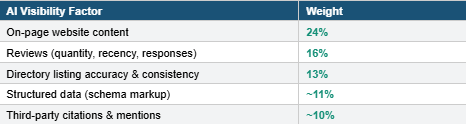
There’s another nuance that catches many practices off guard: when ChatGPT performs live web searches, it retrieves information through Bing’s index — not Google’s. If your website or business listings aren’t visible to Bing, your chances of appearing in AI-generated answers drop dramatically.
This is why directories like Yelp, Healthgrades, RealSelf, and other authoritative platforms carry outsized weight in AI recommendations. Large language models look for businesses that appear consistently across trusted sources. Practices with strong profiles across multiple platforms send clearer trust signals — and are far more likely to be cited when AI tools recommend providers.
One more insight worth noting: 44% of LLM citations come from the first 30% of a webpage's text. This means your most important content — your services, your credentials, your patient value proposition — needs to be clearly stated near the top of your pages. Not buried in paragraph seven. Or in an overcrowded, bulleted list at the bottom of the homepage.
The Visibility Stack: What It Looks Like in Practice
Think of your digital presence as a stack of layers. Each layer serves a different discovery surface. Practices that dominate local patient acquisition in 2026 have — intentionally or not — built all of them.
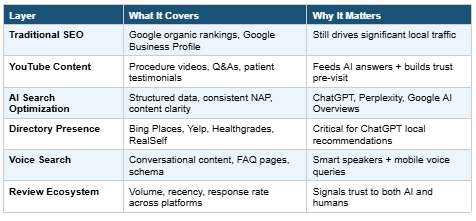
The hard truth? Most cosmetic practices have layer one. A few are experimenting with YouTube. Almost none have intentionally built the remaining four. That's the opportunity.
What Cosmetic Dental Patients Are Actually Asking AI Tools — Right Now
Before you can show up in AI-generated answers, it helps to know what’s actually being asked. Here are the kinds of prompts patients are feeding into ChatGPT and Google AI Overviews when researching cosmetic dentistry:
“How much do porcelain veneers cost and are they worth it?”
“What’s the difference between veneers and Lumineers?”
“Find me a highly-rated cosmetic dentist near [city] who does smile makeovers”
“How long does a full-mouth reconstruction take from start to finish?”
“Are dental implants better than a bridge for a missing front tooth?”
“What should I look for when choosing a cosmetic dentist?”
Notice the pattern: these are conversational, specific, and intent-driven. They’re not short keyword searches — 75% of ChatGPT searches are five or more words long, roughly 60% longer than the average Google query. Patients using AI are already mid-decision. They want detailed, trustworthy answers. And they’re often very close to booking a consultation.
The practices that answer these questions — through well-structured service pages, FAQ content, YouTube videos, and consistent directory profiles — are the ones AI surfaces as trusted recommendations when a patient is ready to act.
Three Things You Can Do This Week
You don't have to rebuild your entire digital presence overnight. Start with these three high-leverage moves:
1. Do Your Own AI Visibility Audit
Open ChatGPT and ask: "What are the best [your specialty] providers near [your city]?" Then ask Perplexity the same question. Then try Google with AI Overviews enabled. What comes back tells you exactly how visible you are — and where the gaps are. Most practice owners find this exercise illuminating (and a little alarming).
2. Claim and Complete Your Bing Places Listing
Because ChatGPT pulls from Bing's index for local searches, a missing or incomplete Bing Places profile means you're invisible to the world's largest AI search platform. This is a 30-minute fix with a potentially significant payoff.
3. Create One YouTube Video Answering a Real Patient Question
It doesn't need to be produced. It needs to be genuine. Pick the question your consultation team hears most often and record a 5-7 minute answer. Optimize the title and description with the exact phrase patients search, add chapters, and include a transcript. This single video can feed AI search results, build pre-consultation trust, and rank on both YouTube and Google simultaneously.
If You Want Someone to Do This For You
Building out a full visibility stack takes time, strategic clarity, and ongoing attention. If you'd rather have an expert assess where you stand and map out exactly what needs to happen — without having to learn it all yourself — an AI Visibility Audit may be the right starting point.
We review your practice's presence across AI search platforms, traditional search, YouTube, directories, and your review ecosystem. You get a clear picture of where you're visible, where you're invisible, and what to prioritize first.
The Window Is Open — But Not Forever
The practices building visibility stacks right now are doing so in a market where most of their competitors haven't started. That advantage compounds. The practices that moved early on Google Business Profile in 2012 built authority that their late-moving competitors spent years trying to catch up with.
The same window is open today — across YouTube, AI search, and the directory ecosystem that feeds patient recommendations. The question isn't whether this matters. It's whether you'll move before your market gets crowded.
Start with the audit. Build from there.
Need a reference to get started? Grab our Practice Playbook, designed to help you be found first!
Sources & Research
This post was informed by recent research and industry data, including:
BrightLocal Consumer Review Survey 2026 — AI tool usage for local business recommendations
Whitespark 2026 Local Search Ranking Factors — AI Search Visibility category data
Yext — Analysis of 6.8 million AI platform citations of local business data
Search Engine Journal — YouTube CEO Neal Mohan 2026 annual letter coverage (January 2026)
Position Digital — AI SEO Statistics, updated February 2026
PRNewsonline / Exposure Ninja — AI Search and GEO adoption statistics, 2025–2026
RankScience — AI local search visibility research (2025–2026)
Dataslayer / BrightEdge — Google AI Overviews citation and CTR data
OutlierKit — YouTube algorithm updates guide, February 2026
Neil Patel / NP Digital — Local SEO for LLMs, December 2025
Research note: This post draws on data published between late 2025 and early 2026. The AI search landscape is evolving rapidly; specific platform statistics may shift as adoption grows. Where possible, we have cited the most current available sources.
