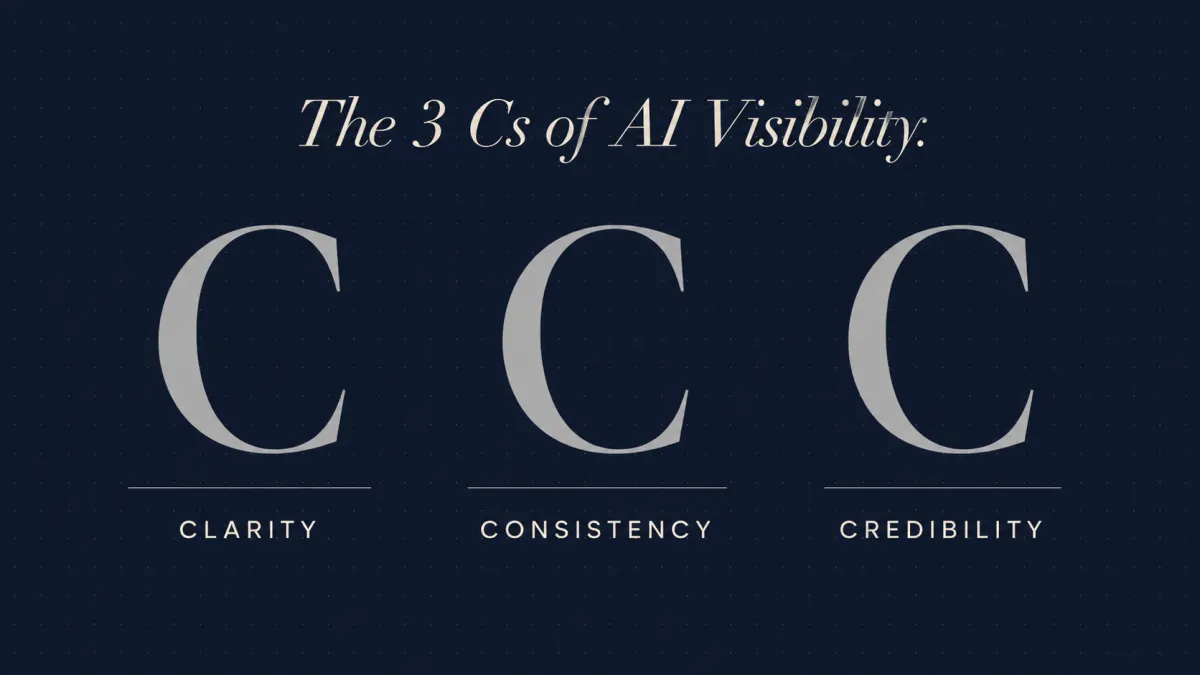
The 3 Cs of AI Visibility: Clarity, Consistency, Credibility
Let's go ahead and say the quiet part out loud: when a patient asks ChatGPT for the best veneer dentist in your city, the model is not judging your dentistry. It has no opinion about your margins, your shade matching, or the case you finished last Thursday that belongs in a textbook.
It is working with whatever it can find about you — your site, a directory profile, a review page, an article, maybe nothing of yours at all. Three things decide whether any of that is usable. Most beautiful, expensive, clinically excellent practices fail all three.
I call them the 3 Cs of AI Visibility: Clarity, Consistency, Credibility. They are not a strategy, and they are not steps — there is no order to work through. They describe the state of your own information: whether it is clear, whether it agrees with itself, and whether anyone outside your practice backs it up.
Let's go through them, because once you see them you can't unsee them in your own practice.
Clarity: can a machine say what you do, in one line, without guessing?
Open your homepage and read it the way a model reads it — no visual hierarchy, no photography, no vibe. Just language.
What most cosmetic practices have written up there is something like "Exceptional dentistry. Extraordinary smiles." That's a mood. It is beautiful on a wall and useless to a machine. It doesn't say what you do, who you do it for, or where you do it.
Clarity means a model can extract three facts from your site without inference: what you do, for whom, and where. Veneers, smile makeovers, full-mouth reconstruction. Fee-for-service, adult, cosmetic-driven patients. This city, this neighborhood.
If your site requires a human to look at a photo and infer that you're a high-end cosmetic practice, you're relying on a reader who isn't there anymore. And here is where the SEO conversation gets uncomfortable: keyword optimization does not automatically produce clarity. A page can rank respectably for "cosmetic dentist [city]" and still fail to state plainly what the practice does. Ranking in a list and being retrievable as an answer are two different jobs. I wrote about that distinction at length in GEO vs. SEO: Why Generative Engine Optimization Is the New Priority.
Consistency: does your practice tell the same story everywhere it appears?
This is the least glamorous C and the one that quietly breaks the most practices.
Your name, address, and phone number exist in more places than you think. Google Business Profile. Your website footer. The old Yelp listing you never claimed. The insurance directory from the year you were in-network. Three dental association pages. A city guide. The listing your previous marketing agency built and never told you about.
If those disagree — different suite number, old phone, a practice name with and without "DDS," an address from two moves ago — there is no single version of your practice to retrieve. Sometimes the current one surfaces. Sometimes what surfaces is the version where you're still in-network with everybody, which is not the practice you spent five years building.
A model can absolutely search the live web. What it cannot do is conduct a live audit of every website that mentions you and adjudicate which one is current. It retrieves what is clear, consistent, and credible enough to surface. Contradiction is not neutral — it's a reason to name someone else.
Credibility: is there evidence, and did somebody other than you provide it?
Credibility is the C most cosmetic practices are already strong at, which is exactly why it's so frustrating when it doesn't help.
Credibility has two halves. There's the evidence you produce — substantive reviews, before-and-afters that show real transformation, patient stories with specifics in them. Then there's the recognition other people confer — press, references from sources with no stake in you, being cited by someone who isn't on your payroll.
If you run a serious cosmetic practice, you likely have both. Your work is genuinely good and the proof exists. That's the whole irritation: the C you're strongest at is the one that can't work alone. Credibility that isn't connected to the question doesn't get used. Your reviews are describing a practice the model can't place.
Reviews are load-bearing here in a way most practices underrate — not for the star average, but for the language patients use in them. If ten people describe the same experience in similar words, that's corroboration. I've made the case for that separately in Why Google Reviews Matter More Than Your Website.
The Cs are the conditions. The Stack is the work.
Here's the piece that makes this usable instead of just anxiety-producing.
The 3 Cs are the conditions your practice has to be in. The AI Authority Stack™ is what you build to get there. Four layers, in build order: Foundation, Answer, Proof, Authority — FAPA. And the mapping is clean:
Clarity comes from Foundation plus Answer
Consistency comes from Foundation
Credibility comes from Proof plus Authority
Look at where the weight sits. Two of the three Cs rest entirely on the bottom of the Stack — the two layers nobody looks at, because they're not visible to humans. Foundation and Answer are the plumbing. Proof and Authority are the finished bathroom.
Most high-end cosmetic practices I look at are top-heavy: outstanding Proof, real Authority, and nothing underneath. Great work, jaw-dropping before-and-afters, strong reviews — and a website built to rank on Google rather than to be read by a model. That's not a marketing failure. It's a sequencing failure. Your SEO agency optimized for a different machine, and Google doesn't control how AI platforms structure their answers.
If you want the version of this that gets specific about owning a single procedure category, that's How to Own One Treatment Category in AI Search Before Your Competitor Does. And if you're at the earlier question of why you're not showing up at all, start with Why AI Search Doesn't Recommend Your Dental Practice.
What to do with this today
Ask ChatGPT to recommend a cosmetic dentist in your city. Don't use your practice name — ask the way a patient would.
Then read whatever comes back against the three Cs. If a competitor got named, ask yourself which C they had that you didn't. It's usually not Credibility. It's almost always Clarity, and it's almost always fixable in weeks rather than quarters.
For a fuller set of answers to the questions dentists actually bring to this, including what's the best way to improve AI visibility for dentists?, the FAQ covers the ground.
And if you'd rather not run the diagnosis yourself: the AI Visibility Audit tests your practice across ChatGPT, Perplexity, and Gemini, scores you against all three Cs, and returns a prioritized action plan in 5–7 days. $247.
Jennie Stoll is the founder of Brilliant Brand Solutions, with 25+ years in professional writing and data analysis, including 13 years in pharmaceutical resea
