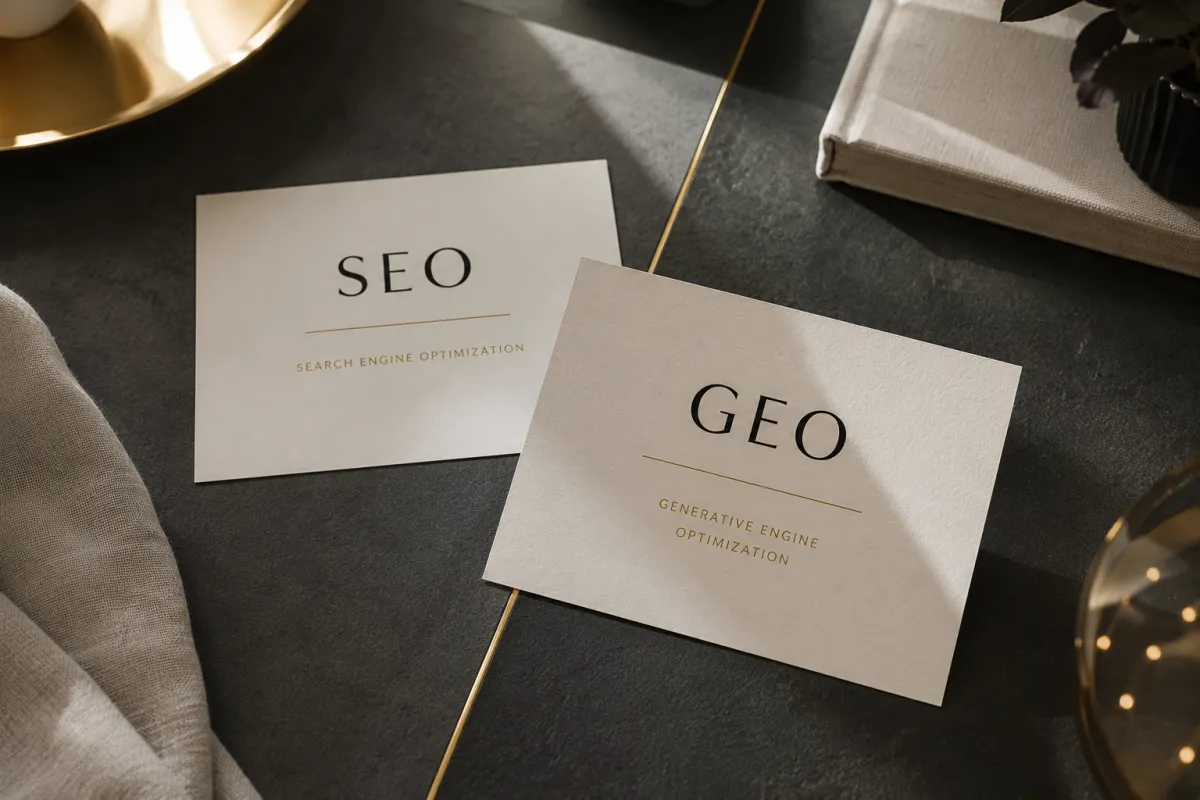
GEO vs. SEO: Why Generative Engine Optimization Is the New Priority
GEO vs. SEO: Why Generative Engine Optimization Is the New Priority
Your SEO is probably fine. That's the problem.
I'm not saying good SEO doesn't matter — it does. But "fine" gets you onto a Google results page that your best prospective patients are spending less and less time reading. While you've been optimizing for Google, the patients considering $15,000 smile makeovers have been asking ChatGPT what cosmetic dentist it recommends in your city. And Google has almost nothing to do with that answer.
This is the distinction most dental marketing conversations miss entirely: Google SEO and AI search are separate systems with separate rules. Ranking well in one does not guarantee visibility in the other. And right now, the overwhelming majority of cosmetic practices are building for a search behavior that is quietly becoming secondary.
What SEO actually does — and doesn't do
Search engine optimization is built around Google's index. You create content, earn backlinks, optimize page speed, and structure your site so Google's crawlers can read and rank it. When someone types a query into Google, your practice shows up — hopefully on page one.
That still matters. Patients still Google. They'll keep Googling for the foreseeable future.
But here's what SEO cannot do: it cannot get you recommended by ChatGPT, Perplexity, Claude, or Gemini. Those platforms don't pull from Google's ranked results. They pull from their own training data, real-time browsing of the broader web, structured credibility signals across multiple sources, and the internal logic of how each model was built. When a patient asks an AI assistant which cosmetic dentist to call, Google's page-one rankings are largely irrelevant to that answer.
Your practice could rank #1 on Google and still be invisible in AI search. That's not a hypothetical. It's happening right now.
In order to have the best chance showing up in any search, you have to optimize for each.
What GEO actually is
Generative Engine Optimization is the practice of building your online presence in a way that AI models can find, understand, and recommend. It's not about tricking an algorithm. It's about making your practice legible to systems that summarize and synthesize information rather than rank links.
Where SEO asks: How do I appear higher in search results?
GEO asks: How do I become the practice an AI mentions when a patient asks for a recommendation?
The answers to those questions are different — sometimes meaningfully so.
Google rewards things like keyword density, domain authority, and click-through behavior. AI recommendation systems pay attention to consistency of information across the web, the specificity of your positioning (are you a dentist, or the cosmetic dentist known for veneers and smile makeovers?), the volume and content of patient reviews that mention specific treatments, and how clearly your digital presence signals what you do and who you serve.
A lot of practices have decent SEO and weak GEO. Excellent website. Spotty review strategy. Inconsistent listings. No treatment-specific content. Generic service pages that describe "comprehensive care" instead of the specific procedures high-value patients are searching for. To Google, that's survivable. To an AI trying to generate a short list of recommended providers, it's disqualifying.
Why this matters more for cosmetic practices than general dentistry
The patients who are most likely to ask AI for help finding a dentist are also the patients most likely to be considering elective, high-dollar cosmetic treatment. They're research-oriented. They're comparison-shopping before they ever reach out. They're not picking a dentist based on who's closest or who's in-network — they're evaluating credibility, specialty, and perceived quality.
That patient profile is your patient profile. Which means the stakes for AI visibility in cosmetic dentistry are higher than in almost any other dental category.
When a patient asks ChatGPT which cosmetic dentist near them does the best veneers, the practices that come up aren't necessarily the most skilled. They're the ones whose online presence gave the AI enough specific, consistent, credible information to generate a confident recommendation. Skill that isn't visible online doesn't count. Specialty that isn't stated clearly doesn't count. Reviews that say "great staff" without mentioning a single treatment don't count.
The practices that understand this now have a window that won't stay open.
What GEO looks like in practice
It starts with specificity. "We offer comprehensive dental services" tells an AI almost nothing. "We specialize in porcelain veneers, full smile makeovers, and minimal-prep cosmetic dentistry for patients who want exceptional results without anesthesia" gives an AI something to work with. Every page, listing, and profile that describes your practice should speak to your actual specialty, in plain language, consistently.
It continues with reviews. Not just more reviews — better reviews. A review that says "I got my veneers here and could not be happier with the result" is exponentially more valuable for AI visibility than a five-star rating with no written content. Coaching your team on how to invite specific, treatment-mentioned reviews is one of the highest-ROI things a cosmetic practice can do right now.
It extends to your Google Business Profile, your directory listings, your website structure, and any third-party mentions of your practice. AI models cross-reference information. When your name, specialty, and location appear clearly and consistently across multiple sources, you become easier to recommend. When that information is inconsistent, incomplete, or buried under generic language, you don't.
And it requires thinking about your content differently. The blog post or FAQ that answers "What's the difference between veneers and crowns?" isn't just helpful to patients — it's the kind of structured, specific, educational content that AI models cite when they're generating answers. You're not just building for human readers anymore. You're building for systems that are going to summarize your expertise and either include you or skip you.
If you want a deeper look at how AI actually changed the patient journey that leads to your door — and what that means for every touchpoint in your practice — The New Patient Journey Has Changed — Here's What AI Search Did to It is worth reading before you go any further.
SEO vs. GEO: not either/or, but not equal
None of this means you should abandon your SEO strategy. Good website architecture helps both systems. Relevant, well-written content helps both systems. A strong Google Business Profile helps both systems. There's meaningful overlap.
But GEO is not an extension of SEO. It's a parallel discipline with its own logic, and treating it as an afterthought — or assuming that your Google rankings will carry over into AI recommendations — is a bet that is quietly not paying off for a lot of cosmetic practices right now.
The dentists who are showing up in AI results are doing something specific. It's learnable, it's buildable, and it's not as complicated as the acronym makes it sound. It just requires understanding the rules of a system that most of your competitors haven't thought seriously about yet.
Related Posts
The AI Visibility Playbook walks through exactly what GEO requires — what signals AI looks for, how to build them, and a 30-day action plan your team can follow without a marketing agency. It's $27 and it's built specifically for cosmetic dental practices.
