Zero-Click Search and What It Means for Your Practice's Online Visibility | Brilliant Brand Solutions
Woo hoo!!! You ranked number one on Google. Congratulations.
Now here is the uncomfortable truth: that position is delivering 58% fewer clicks than it did two years ago.
Not because your ranking dropped. Because the search results page changed around you.
According to Ahrefs' February 2026 study of search behavior, the presence of an AI Overview now correlates with a 58% lower click-through rate for the top-ranking page. For every 100 clicks a position-one result historically earned, Google now keeps 58 of them — answering the query directly on the search page before the user ever decides to visit your site.
Red Alert: This is not a temporary algorithm update. It is a structural shift in how patients find information — and for cosmetic dental practices that have built their new patient pipeline around SEO traffic, it is a change worth understanding clearly.
I'm seeing a significant number of SEO/marketing/digital agencies saying that being SEO optimized is all you need.
Think again. Do your own research. Getting found now is a whole different process than when your website was optimized for Google 2015. (Honestly, if your website hasn't been updated in the last 12 months, ensuring that AI can read your signals, this needs done pronto. But I digress...)
What Zero-Click Search Actually Is
Zero-click search is exactly what it sounds like: a search that ends without the user clicking to any external website. The query is typed, the search page loads, the answer appears — and the user leaves satisfied without ever visiting your site, your competitor's site, or anyone else's.
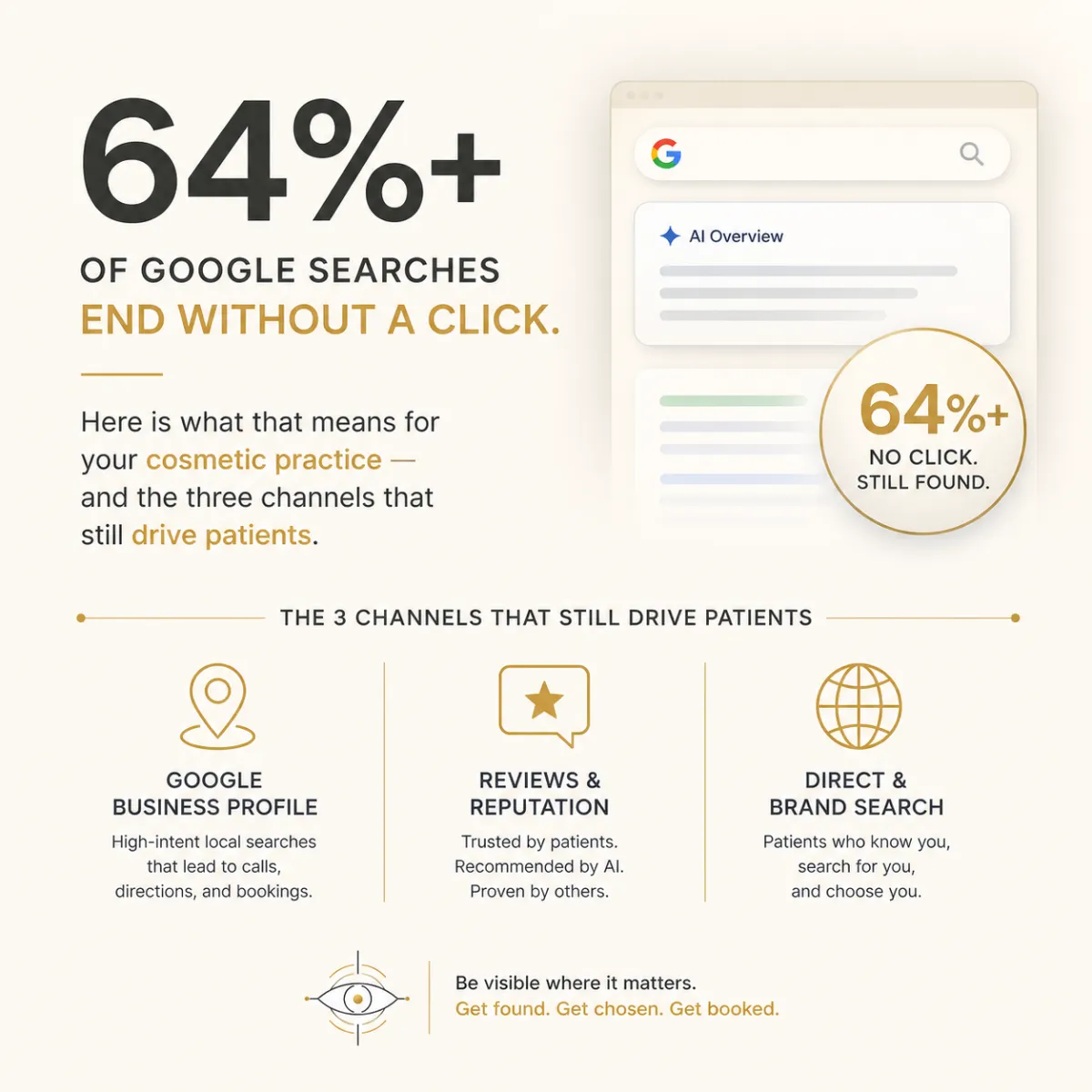
This behavior is not new. But AI has accelerated it dramatically. According to SparkToro and Datos data updated through 2026, 64.82% of all Google searches currently end without a click. On mobile — where 63% of total Google queries originate — that number rises to 77%. Forrester projects the rate will exceed 70% across all devices by 2028.
The driver is AI Overviews: Google's AI-generated summary answers that appear at the top of search results for a growing share of queries. Ahrefs' December 2025 data found that AI Overviews are now present in a meaningful percentage of searches and are directly suppressing click-through rates at every organic ranking position. Position two sees a 50.8% CTR reduction. Position three, 46.4%. Even a position-ten listing loses nearly 20% of its expected clicks when an AI Overview is present above it.
For informational queries — "how long do veneers last," "what is a smile makeover," "does dental insurance cover Invisalign" — the answer now lives on the search page. The patient gets what they need and moves on. Your website is not part of the transaction.
Why This Matters Differently for Cosmetic Practices
There is a meaningful distinction between how zero-click search affects a general dental practice and how it affects a high-dollar cosmetic one — and it runs in your favor, if you understand it.
General dental searches are increasingly dominated by informational zero-click outcomes. Patients searching "does whitening work on crowns" or "what causes cavities" are getting those answers directly from Google. That traffic was never your highest-value channel anyway.
What matters for a cosmetic practice is what happens with high-intent local queries: "cosmetic dentist near me," "veneers consultation [city]," "best cosmetic dentist for smile makeover." These are the searches that produce appointments.
The good news: local queries with high commercial intent are among the most resistant to zero-click outcomes.
According to research from Semrush, local-intent searches still drive strong click and call behavior — particularly through Google Maps and the local pack, which surface a practice's Google Business Profile directly. When a patient searches for a cosmetic dentist in a specific area with intent to book, they are looking for a practice, not an answer. That behavior still converts.
The challenge is that even local searches are changing. AI Overviews are now appearing for an increasing share of local queries. Google Maps results are being compressed by AI-generated responses.
Practices that invested in blogs, FAQ pages, and treatment explainers are seeing a shift in how that content performs. It may attract fewer early-stage clicks because AI increasingly answers informational questions before a searcher reaches a website.
That does not make educational content less important. Clear, specific, well-structured content has become part of a practice’s visibility infrastructure — helping AI understand services, evaluate authority, and determine which practices feel credible enough to recommend.
The New Role of Your Website Content
Here is the shift that most cosmetic practices have not processed yet: the goal of website content is no longer to rank and receive clicks. The goal is to be cited.
When an AI Overview appears at the top of Google, it pulls from specific pages — and those pages, if cited in the AI-generated answer, receive a higher click-through rate than they would from a standard organic listing, according to Google CEO Sundar Pichai's own statement. Links that appear inside an AI Overview are clicked more often than equivalent links in traditional search results.
In other words, the pages that win in the zero-click era are the ones that AI trusts enough to cite. That is a meaningfully different quality bar than simply ranking.
Read that again. I'll wait.
My Social Practice's 2025 dental SEO research found that over 82% of AI Overview citations come from pages buried two or more levels deep into a website — not homepages, not service landing pages, but specific, substantive, question-answering content. Blog posts about how long veneers last. FAQ pages that address sedation options. Procedure-specific pages that actually explain the treatment process.
Thin content, templated service pages, and generic homepage copy are not getting cited. Specific, well-structured, patient-question-focused content is. The practices that have invested in depth — real answers to real patient questions, organized clearly — are the ones showing up in AI-generated responses.
This means the work of content creation has not become less important. It has become more specific.
Gone are the days of creating content simply to create content. To be seen. To stay relevant. Your content needs substance and signals that AI can read so it can recommend you (or your competitor, whomever is most clear, consistent and authoritative).
The Three Channels That Still Drive Patients in a Zero-Click World
Zero-click search does not mean zero patients from search. It means the channels that matter have shifted. For cosmetic practices in 2026, three channels are doing the heavy lifting.
Google Business Profile
Your GBP is the single most durable visibility asset in a zero-click environment. It surfaces directly in local search results independent of AI Overviews. It populates Google Maps, which still drives strong call and direction behavior from high-intent searchers. Verified businesses receive an average of over 21,000 views per year through Google searches, and a fully optimized profile dramatically increases map pack visibility.
I need you to read this carefully:
For cosmetic practices, completeness matters: photos, services listed with specific treatment names, regularly updated posts, accurate hours, and consistent NAP information across all directories. This is not optional housekeeping. It is the foundation of local search presence.
Review Specificity
Reviews are still heavily weighted in local AI recommendations — but the quality of the review matters more than the volume. AI platforms favor reviews that mention specific treatments, describe the experience in detail, and use natural language that maps to search queries. "Dr. Chen transformed my smile with porcelain veneers and I could not be happier" is worth more in the AI visibility ecosystem than twenty reviews that say "great dentist, highly recommend."
Encouraging specific, treatment-named reviews from cosmetic patients is one of the highest-return activities a practice can invest in — and it works simultaneously for Google rankings, AI recommendations, and human social proof.
But you also need to proceed with caution regarding reviews. Google recently updated their reviews policy. You are more limited in what you can ask your patients to do as well as in the manner. You can read more here.
Deep Content on Treatment Pages
The third channel is the one most practices are underinvesting in: specific, substantive content on procedure pages that directly addresses the questions patients ask before they call. Not a paragraph about veneers — a full, honest, well-organized page that answers how the process works, what results to expect, how to know if you are a good candidate, and what recovery looks like.
These pages are what AI cites. They are what surfaces in AI Overviews for treatment-specific queries. They are what a patient reads at 11pm while deciding whether to book a consultation. For a cosmetic practice, they are the most efficient content investment available right now.
What This Means for Your Visibility Strategy
The zero-click era does not make digital marketing harder for cosmetic practices that understand what is happening. It makes it clearer.
The practices that will win are the ones that stop chasing traffic metrics and start building presence — in Google's local ecosystem, in AI-generated answers, and in the specific places high-intent cosmetic patients go when they are ready to move forward.
That means a complete, actively managed Google Business Profile. A review strategy built around specificity. Procedure content that is substantive enough to be cited by AI. And an understanding of which queries are still driving clicks — and which ones to stop optimizing for entirely.
If you want a clear-eyed look at where your practice stands in the AI visibility ecosystem — what AI is finding when it searches for you, where the gaps are, and what to fix first — the AI Visibility Audit is designed to answer exactly those questions.
This is the shift. The practices that see it early and build accordingly are the ones that will be the recommended answer when a patient asks AI who to trust with their smile.
Yesterday was the optimal time to ensure your practice is optimized for today's search guidelines.
Today is the next best. Early adopters will see the benefits of updating their visibility strategy now and long-term.
Sources & Further Reading
Ahrefs — AI Overviews Reduce Clicks by 58% (February 2026)— Updated study on AI Overview impact on click-through rates at every organic ranking position.ahrefs.com/blog/ai-overviews-reduce-clicks-update
Searchlab — Zero-Click Search Statistics 2026— Comprehensive data compilation from SparkToro, Semrush, SimilarWeb, and Forrester on zero-click rates, device breakdowns, and projections.searchlab.nl/en/statistics/zero-click-searches-statistics-2026
My Social Practice — AI Overview for Dentists: How Google Impacts SEO— Dental-specific analysis of AI Overview citation behavior, content depth requirements, and GBP optimization for local search.mysocialpractice.com/2025/04/ai-overview-for-dentists
OmniFunnel Marketing — Dental Practice Local SEO: Dominate Search with AI in 2025— Data on local search click behavior, Google Maps pack performance, and AI-enhanced SEO strategies for dental practices.omnifunnelmarketing.com/blog/how-dental-practices-can-dominate-local-search-with-ai-enhanced-seo
