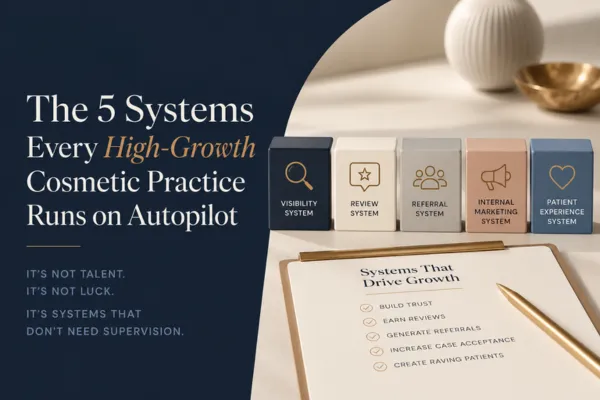
The 5 Systems Every High-Growth Cosmetic Practice Runs on Autopilot
The most successful cosmetic practice in your market is probably not the most talented one.
That's uncomfortable, but you already know it's true. You've seen the work coming out of practices that stay booked three months out, and some of it is good — not great. Meanwhile, dentists doing genuinely exceptional cosmetic work are sitting on open chair time wondering what they're missing.
Here's what they're missing: the busy practice isn't "out-dentisting" them. It's "out-systeming" them.
High-growth cosmetic practices don't rely on the doctor's hustle, the office manager's memory, or a marketing push that happens whenever someone has a free afternoon. They run five specific systems that operate whether or not anyone is thinking about them. That's the entire difference. Not talent. Not luck. Not location. Systems that don't need supervision.
Most practices have two of the five, running inconsistently. Let's walk through all of them.
System 1: The Visibility System
This is how new patients find you without anyone in your office lifting a finger.
Ten years ago, this meant Google rankings. Today it means Google and AI search — because the patient considering a $15,000 smile makeover is increasingly asking ChatGPT or Perplexity who to call, not scrolling page one. Your visibility system is the combination of a clearly positioned website, a fully built-out Google Business Profile, consistent information across every listing, and treatment-specific content that both Google and AI models can read and cite.
The key word is system. A website you launched in 2023 and haven't touched since is not a system — it's an artifact. A visibility system has a maintenance rhythm: content published on a schedule, listings checked quarterly, positioning language kept identical everywhere your practice appears. If you want to understand why the AI half of this now matters as much as the Google half, GEO vs. SEO: Why Generative Engine Optimization Is the New Priority breaks it down.
System 2: The Review System
Not "we ask for reviews when we remember." A review system means every completed cosmetic case triggers a specific, timed request — and your team knows how to invite reviews that mention the actual treatment.
This matters more than most practices realize. A five-star rating with no written content is nearly worthless to an AI deciding which practice to recommend for veneers. A review that says "I got my veneers here and the process was incredible" is a credibility signal that compounds. The difference between those two outcomes isn't patient enthusiasm. It's whether your team was trained to ask the right way, at the right moment, every single time.
On autopilot, this looks like: a defined trigger point (final appointment, seat date, post-op check), a scripted-but-human ask, an automated follow-up if the review doesn't appear within a week, and a monthly count someone actually looks at.
System 3: The Referral System
Referrals feel like luck. In high-growth practices, they're engineered.
A referral system gives your happiest patients a reason, a moment, and a mechanism to send people your way — instead of hoping they mention you at a dinner party. That means identifying your referral-likely patients (big transformations, emotional outcomes), creating a deliberate touchpoint after the case is complete, and making the referral itself effortless.
I've written a full breakdown of this one: How to Build a Referral System That Doesn't Depend on Luck. The short version — if you can't describe the exact path a referral takes from a patient's mouth to your schedule, you don't have a referral system. You have referral hope.
System 4: The Internal Marketing System
Here's the one almost everyone skips, and it's sitting on the most revenue.
Your existing patient base already trusts you. They're already in your chairs. And a meaningful percentage of them would say yes to cosmetic treatment — whitening, bonding, veneers, a full smile refresh — if the conversation happened consistently. In most practices, it doesn't. It happens when the doctor has energy, when the hygienist thinks of it, when the schedule is light. And this doesn't have to be a used car salesman pitch. Just a genuine conversation about what you offer.
An internal marketing system makes that conversation structural: hygiene teams trained to notice and mention, consistent language across the whole team, follow-up on unscheduled treatment, and case presentation that doesn't depend on who's working that day. If case acceptance is the metric you care about, Internal Marketing Systems That Increase Case Acceptance goes deep on this.
System 5: The Patient Experience System
This is the one that powers the other four — and it's the one practices most often believe they have when they don't.
Think about what the first four systems actually run on. Reviews worth writing come from experiences worth describing. Referrals come from patients who felt something they want other people to feel. Internal marketing only works when patients trust the team enough to hear a treatment recommendation as care instead of a sales pitch. Even your visibility system ultimately depends on experience, because AI models are reading what your patients say about you.
A patient experience system means the experience is designed — not dependent on everyone having a good day. The phone greeting is defined. The new patient arrival is choreographed. The consult environment is intentional. The follow-up after a big case is automatic. Every touchpoint either builds the perception of a premium practice or quietly erodes it, and in a system, none of those touchpoints are left to chance.
Most practices grade themselves on friendliness. High-growth practices grade themselves on consistency. Those are not the same thing. And they aren't mutually exclusive. You can create consistency all while being friendly.
The honest self-assessment
Go through the five again and ask one question about each: would this still run if the person currently responsible for it took a month off?
If the answer is no, it's not a system. It's a person doing their best. People doing their best is how good practices stay stuck at good. Systems running on autopilot is how good practices become the obvious choice in their market.
You don't build all five at once. But you do need to know which ones you're missing — and for most cosmetic practices, the fastest place to start is the fifth, because it feeds everything else.
Related Posts:
Wondering where your patient experience actually stands? The free Patient Experience Thriving Checklist scores your practice in under two minutes — and shows you exactly where the experience is costing you referrals, reviews, and revenue.
